Wednesday, February 8, 2023

Insa-dong unique experience hot place recommendation

It's spring in Korea from March..
I'm waiting for the cherry blossoms in full bloom..
 Wouldn't it be nice to enjoy the wonderful winter before spring arrives?

Insa-dong unique experience hot place recommended

1. Today's Hanbok

오늘하루한복

 
If you go on a date in Insa-dong, 
you can't miss a Hanbok date!
Wouldn't it be pretty to take a picture with the old palace as the background?


Photo: Today's Hanbok
Tip) If you are a couple, ask the boss to recommend fusion couple hanbok!
 

Cost
Princess Hanbok experience (4 hours) KRW 24,000
Bocchan Hanbok experience (4 hours) KRW 17,000
Business Hours
10:30 ~ 20:00 Open all year round
0504-3109-7933
Location
Anguk Station Exit 6, 6 minutes on foot
 
 
2. Idus Store
Offline store of Ideas,
the leading handmade online shop!!
A chance to go and see the products
you've always been eyeing!
Meet the charm of handmade,
unique products made by yourself


Location
Anguk Station Exit 6 6-minute walk Ideas on the 3rd floor of Ssamzie -gil

3. Makebrick 
Makebrick located on the 5th floor of the multiplex 'Hello Insa-dong'
The brick looks like a broken picture file if you look closely.
It's attractive to see clearly from a distance!


It can be used as a unique and stylish interior accessory.
This store, like an exhibition hall, has many photo zones where you can take life shots.
Great for making memories with couples or families.


You can also make brick art directly from a picture on your smartphone!
It would be meaningful to give a gift on a special day, right?
  • Location: 5th floor, 49 Insadong-gil, Jongno-gu, Seoul
  • Business Hours: Daily 10:00 ~ 21:00

There are so many things to do and eat in Insadong, from workshops to theme parks!

Get ready to go to Insa-dong

Saturday, February 4, 2023

Introducing Great Travel Places - #1

 방탄소년단 앨범 〈버터〉 재킷 촬영 시설물을 재현한 맹방해변

Maengbang Beachwhere the shooting facilities forthe jacket of BTS' album 〈Butter〉 were reproduced
There are two beaches in Samcheok that have become popular spots for the Korean Wave. It is the beach of ‘butter’ and ‘machimnae’. The beach of 'Butter' is the beach where BTS' album <Butter> was filmed. This is the place where member J-Hope admired while filming, “Is it like synthetic, the sea?”
Bunam Beach where the final scene of the movie 〈Decision to Leave〉 was filmed

The beach in 'Machimnae' is Bunam Beach, where the last scene of the movie 'Decision to Leave' was filmed. ‘Machimnae’ is a Masung's speech this work. Maengbang Beach is best when the sun is shining, and Bunam Beach is better in the afternoon when the sun starts to tilt toward the west. This is why Maengbang Beach is sweet like the melody of BTS, and Bunam Beach is like <Decision to Leave>, which is why I wrote it in my heart.

Maengbang Beach, called ‘BTS Beach’ instead of Myeongsasimni

Maengbang Beach is one of the best beaches in the East Sea. Usually, ‘the beach with fine and soft sand stretches endlessly’ is given the modifier Myeongsasimri, so Maengbang Beach has been called Myeongsasimni for a long time. Now, a new modifier called ‘BTS beach’ has been created. The album 〈Butter〉, whose jacket was filmed on Maengbang Beach in March 2021, ranked first on the Billboard’Hot 100 Chart’ upon its release, and stayed at the top for a total of 10 weeks.

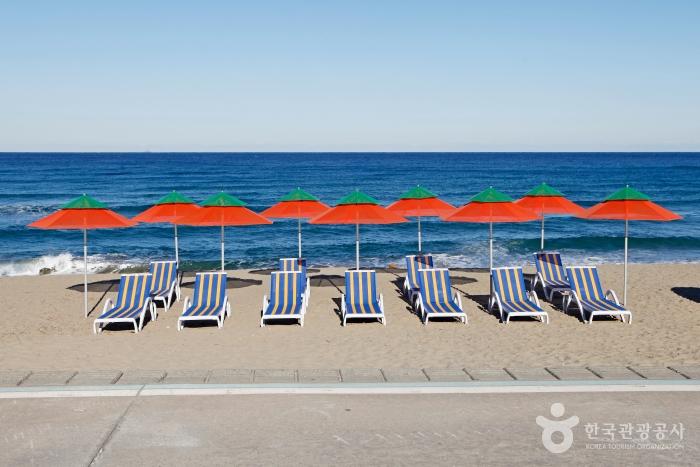
 Maengbang Beach has also been reborn as a Hallyu hotspot. In July 2021, the shooting concept in the album was reproduced, and from October 2022, the props that appeared on the jacket were rearranged to meet travelers. Orange and green parasols, blue and yellow striped sunbeds, and beach volleyball nets and boards all look like jackets. There, it is not only 'Army' (BTS official fan club) who takes certified photos like BTS in the album photo. Regardless of gender, regardless of age. The sea spreading is as refreshing as a song by BTS.

 Member Jungkook, who sang “Dreamers,” the theme song for the 2022 Qatar World Cup, soothed the regret of “I wanted to see the winter sea but couldn’t come,” and put on a happy expression, saying, “I like that the sound of the sea really calms people down. I nod my head at those words. The sound of the winter sea at Maengbang Beach calms the mind. However, I can't help it that 'butter' is lingering in my ears". A humming song of ‘smooth like butter’ flows out, and as you walk on the sandy beach, the enchanting sea light of the allies seems to ‘breakin’ into your heart like that’ in an instant.

If the protagonist of the Samcheok sea in 2021 is Maengbang Beach, then in 2022 it is Bunam Beach. The secret beach managed by the village had a lot of mania from before. The unpretentious coastline and the rocky mountains to the south are cinematic. And in June 2022, after director Park Chan-wook's "Decision to Leave" was released, this place finally became a place of love between Hae-joon (Park Hae-il) and Seorae (Tang Wei).

Bunam Beach is located 6-7 km south of Maengbang Beach. Get off National Road No. 7 (Donghae-daero) and enter Bunam 2-ri village road. The entrance to the beach from the parking lot is quite dramatic after passing through the bamboo forest stairs. At the end of the stairs, you can see a rocky mountain across the front sand field. Unlike the movie, there is only one house inside the rocky mountain, and there are only fierce waves between the rocks. Seorae walking into it overlaps with Haejun chasing her. It also reminds me of 《Mountains and Seas》 that Seorae cherished. The picture that looks like a mountain or the sea and the Hangeul that Tang Wei wrote himself were impressive, and the rocky mountain at Bunam Beach seems to have reproduced it. Therefore, at Bunam Beach, everyone inevitably and finally becomes Seorae and Haejun, recalling memories of past love.

Isabusaja Park was created to honor the pioneering spirit and spirit of Silla general Isabu. There is 'Samcheok Picture Book Country' at the summit. The space decorated by the picture book writers themselves is composed of five exhibition halls. A net playground with a view of the sea outside the window, a jungle gym, and a beehive playground arouse children's interest. The experience of reading picture books in the big-book-zone and hammock is also fun. Experts are always there to help you read and experience books. Admission is managed 3 times a day (09:30, 13:00, 15:30), with 100 people per synagogue. Outdoors, sculptures welcome you, and the promenade leading to the beach is elegant.

Beyond the wall, Naritgol Sensitive Village has charming alleys and murals. Naritgol means ‘the village where Naru used to be’. The scenery of the mountain village of the fishing village from the 1970s and 1980s remains, and if you look around while walking through the alleys, you can see the scenery of Samcheok Port and the sea at a glance. Some roads are not clearly distinguished from the yard of the house, so be careful not to be a nuisance to the residents. There are parking lots throughout the town, but the starting point is usually toward Samcheokhang Snow Crab Street, where the Naritgol Malangi Super and the Naritgol Information Center are located.

If you are traveling to Gagok or Dogye in the inland of Samcheok, the Gagok Foot Bath Experience Center is also suitable as a winter destination. It is operated by Gaon Valley Recreation Village and uses sulfur-containing hot spring water. Before the foot bath, apply sulfur jet gel to your neck and shoulders, soak your feet in hot spring water for 20 to 30 minutes, rub your feet with salt, and apply aroma oil. The scenery of Gagokcheon stream comes in at a glance through the window, making the body and mind more comfortable. In February, a sulfur hot spring is scheduled to open next to the foot bath experience center.

travel course

Hallyu Travel / Beyond the Wall, Naritgol Gamseong Village → Maengbang Beach → Bunam Beach
Winter sea trip / Isabusaja Park (Samcheok Picture Book Country)→naritgol Gamseong Village beyond the Wall→Maengbang Beach→Bunam Beach


Thursday, February 2, 2023

How to buy subway tickets in Korea

 How to buy subway tickets지하철 노선도 - 국문


Public transportation and taxis in Seoul have an extensive service network. Consistently selected as one of the best subways in the world for its ease of use, cleanliness, and short service intervals, the Seoul subway is the most efficient means of transportation for sightseeing in Seoul. Trains run non-stop from approximately 5:30 am to midnight. The entire subway line has a color that symbolizes each line, and signs at all stations are written in Korean, English, and Chinese characters. When riding the subway, you must use a disposable transportation card or transportation card. Single Journey Ticket can be purchased at subway stations, and the fare is the exact fare to the destination plus a refundable deposit of 500 won. Transportation cards called T-money can be purchased at most convenience stores. Transfers between subway lines are free, and transfers between buses and subways are also free for T-money holders. Smartphone and tablet users can download a variety of apps that provide route, time, and transfer information in English, such as Seoul Subway, Metroid nationwide subway information, and Kakao Subway Navigation.


Classification of passengersT-moneyOne-time transportation card
normal (19+)1,250 won1,350 won
Teenager(13~18)720 won1,350 won
children (6~12)450 won450 won


※ Additional charges apply for Airport Railroad and Sinbundang Line.
※ 10 - 50 km: 100 won added per 5 km
※ Over 50km: 100 won added per 8km
※ T-money holders receive a 100 won discount off the adult fare for each ride.


How to ride


1. Subway station signs are written in Korean and English, in colors that symbolize the route, and numbers are marked at each exit.

2. One-time transportation cards can be purchased from ticket vending machines located in stations. A deposit of 500 won is required, and this amount will be returned when you return the card at the arrival station (if you purchased a T-money transportation card, this process is not required).
영어로 된 메뉴 선택
Menu selection in English
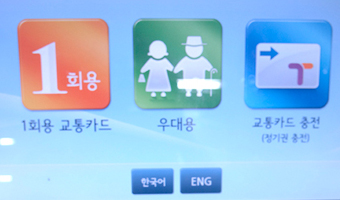
1회용 교통카드 선택
Select “Single Journey Ticket”
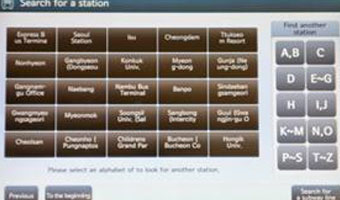
행선지 선택
select station
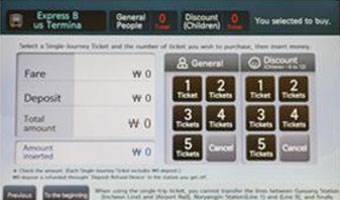
승객 수 선택 후 요금 투입
Enter fare after selecting the number of passengers
3. When passing through the ticket gate, swipe your card over the transportation card reader.

4. Transfers are made within the station. Follow the signs (identified by the color of the symbol) to the desired route.

5. When you arrive at your destination, swipe your card over the transportation card reader at the ticket gate. If you used a disposable transportation card, return the card to the “guaranteed refund machine” and get your 500 won deposit back.

6. If the balance of the T-money card or single-use transportation card is insufficient, you can use the fare adjustment machine near the ticket gate to add more money.
 

Korea's Transportation information for travelers

 Korea is a fascinating country with a rich culture, history, and natural beauty. For travelers visiting Korea, the country’s transportation system is an important aspect to consider as it will determine how easily and comfortably they can explore the country. With a range of modes of transport available, including high-speed trains, subways, buses, and taxis, Korea’s transportation system is considered one of the best in the world.


In this blog post, we will provide valuable information for travelers to help them navigate Korea’s transportation system, including tips on the best ways to get around, how to purchase tickets, and how to get from the airport to their destination.


Getting Around Korea


1. Subway

The subway system in Korea is one of the most efficient, convenient, and affordable ways to get around. It operates in major cities, including Seoul, Busan, and Daegu, and is considered the most popular mode of transportation in the country.

To use the subway, travelers will need to purchase a T-money card, which is a rechargeable card that can be used on the subway, buses, and taxis. To add credit to the card, travelers can use the ticket machines located in subway stations.


2. Buses

Buses are also a popular mode of transportation in Korea, and they offer a convenient and affordable way to travel between cities and rural areas. To use the bus system, travelers will need to purchase a T-money card or pay with cash.


3. Taxis

Taxis are widely available in Korea and are a convenient option for those who do not want to use the subway or buses. Taxis are relatively affordable and can be easily hailed on the street or booked in advance.


4. Cars

For travelers who want more independence and flexibility, renting a car is an option. However, it is important to note that driving in Korea can be challenging, as the roads can be busy and navigation can be difficult.


5. Trains

Trains are a popular mode of transportation in Korea, and the country’s high-speed KTX (Korea Train Express) trains are considered some of the fastest and most advanced in the world. To use the train system, travelers can purchase tickets from the ticket counters or vending machines located in the train stations.


Getting from the Airport to Your Destination


When traveling to Korea, most travelers will arrive at either Incheon International Airport or Gimpo International Airport. To get from the airport to their destination, travelers have several options, including:


1. Airport Express Train (AREX)

The Airport Express Train, also known as AREX, is a high-speed train that connects Incheon International Airport to the city center. Travelers can purchase tickets from the ticket machines located in the airport or from the ticket counters.


2. Buses

Buses are also an option for getting from the airport to the city center. Travelers can purchase tickets from the bus ticket counters located in the airport.


3. Taxis

Taxis are widely available at the airport and are a convenient option for those who do not want to use the train or bus. It is important to note that taxis are metered, and the fare will depend on the distance traveled.


Tips for Navigating Korea’s Transportation System


1. Plan ahead

Before traveling, it is a good idea to plan your journey and research the best modes of transportation to get from one place to another. This will help you save time and avoid any unexpected delays.


2. Use the T-money card

The T-money card is a convenient and cost-effective option for travelers as it can be used on the subway, buses, and taxis. It is also easy to add credit to the card using the ticket machines located in subway stations.


3. Allow extra time for rush hour

During rush hour, which typically occurs between 7:00 am and 9:00 am and between 5:00 pm and 7:00 pm, the subway and buses can be very busy. To avoid being caught in the crowds, it is recommended to allow extra time for travel during these times.


4. Learn basic Korean phrases

Although many signs in subway stations and on buses are written in both Korean and English, it is always helpful to learn basic Korean phrases, such as “Where is the subway station?” or “Where is the bus stop?”. This will make it easier to ask for directions and make your journey more smooth.


5. Use maps and navigation apps

Using a map or a navigation app can be helpful for finding your way around the city, especially when using the subway or buses. Many navigation apps, such as Google Maps, also provide real-time updates on transport schedules and disruptions. I recommend Naver Map.


Conclusion


Korea’s transportation system is considered one of the best in the world, offering travelers a range of options for getting around, including the subway, buses, taxis, cars, and trains. With a little bit of planning and preparation, travelers can make the most of their time in Korea and easily explore all that the country has to offer. Whether you are looking for an affordable, convenient, or fast mode of transportation, Korea’s transportation system has something to offer for everyone.

Korean Culture: A Rich and Diverse Heritage

 Korean Culture: A Rich and Diverse Heritage

Korean culture is a rich and diverse heritage that has evolved over thousands of years. It is the result of the blending of ancient traditions with modern influences and has been shaped by the unique history and geography of the Korean Peninsula. From its traditional arts and music, to its food and fashion, Korean culture is a reflection of the hard-working and creative spirit of the Korean people. In this blog post, we'll explore some of the most interesting and important aspects of Korean culture and see why it has become one of the most popular and sought-after cultural experiences in the world.


Traditional Arts and Music

One of the most important and recognizable aspects of Korean culture is its traditional arts and music. Korean traditional arts include everything from painting and sculpture to calligraphy and crafts. These arts often depict Korean folklore and legends and are known for their intricate details and bold colors. Korean music, on the other hand, is a diverse genre that ranges from classical court music to contemporary pop music. Some of the most popular forms of Korean music include Pansori, a form of opera that dates back to the Joseon Dynasty, and Samul Nori, a percussion-based music that originated from the traditional farmer's music.


Food and Cuisine

Another important aspect of Korean culture is its food and cuisine. Korean cuisine is known for its bold flavors and spices, and for its emphasis on healthy and nutritious ingredients. Some of the most popular dishes include kimchi, a spicy pickled vegetable dish, bibimbap, a rice bowl topped with vegetables and meat, and bulgogi, marinated beef that is grilled or stir-fried. Korean cuisine also features a wide range of traditional teas and drinks, such as green tea, traditional Korean tea, and soju, a popular alcoholic beverage made from rice.


Fashion and Beauty

Korean fashion and beauty are also an important part of the country's culture. From traditional hanboks to modern streetwear, Korean fashion is known for its unique sense of style and creativity. In recent years, Korean beauty products have become incredibly popular around the world, with millions of people seeking out the latest skincare and makeup trends. Korean beauty products are known for their quality, natural ingredients, and innovative formulas, and many of the country's top beauty brands have become global leaders in the industry.


Sports and Leisure

Korean culture is also reflected in its sports and leisure activities. Some of the most popular sports in Korea include taekwondo, a form of martial arts that originated in Korea, and baseball, soccer, which is known as one of the most popular sports in the country. Korean leisure activities also include traditional games, such as yut, a board game played during the Lunar New Year, and games like Go-Stop, a popular card game that is played by people of all ages.


Language and Education

The Korean language is another important aspect of the country's culture. Korean is the official language of South Korea and is spoken by over 80 million people around the world. Korean is a unique and complex language that has evolved over thousands of years, and is known for its rich grammar and vocabulary. Education is also a central part of Korean culture, with a strong emphasis on hard work, discipline, and academic achievement. Korean schools are known for their rigorous curriculums and high standards, and many Korean students go on to attend prestigious universities and colleges both in Korea and around the world.


Religion and Spirituality

Religion and spirituality are also important aspects of Korean culture, with a rich tradition of both Buddhism and Confucianism. Buddhism, which originated in India, was introduced to Korea in the 4th century and has since become an integral part of Korean culture. Confucianism, on the other hand, is a Chinese philosophy that was introduced to Korea in the 7th century and has played a major role in shaping the country's cultural values and moral beliefs. Despite the influence of these two major religions, there is also a strong tradition of shamanism and animism in Korean culture, which is reflected in the country's traditional festivals, rituals, and beliefs.


Family and Community

Family and community are also central to Korean culture. Koreans place a strong emphasis on family values, and families are expected to support each other through thick and thin. The traditional Korean family is patriarchal, with the eldest male being the head of the household. However, over the years, the role of women in Korean society has changed, and many women are now leading successful careers and playing a more active role in their families and communities.


Conclusion

In conclusion, Korean culture is a rich and diverse heritage that has been shaped by the unique history and geography of the Korean Peninsula. From its traditional arts and music to its food and fashion, Korean culture is a reflection of the hard-working and creative spirit of the Korean people. Whether you are interested in exploring its ancient traditions or experiencing its modern influences, Korean culture is a truly fascinating and rewarding experience. Whether you are a fan of Korean pop culture or simply interested in learning more about the country's rich heritage, there is something for everyone in the world of Korean culture.

Korea travel guide

Korea travel guide


Korea is a fascinating country with a rich history, vibrant culture, and stunning landscapes. From bustling cities to serene natural wonders, there's something for everyone in this captivating destination. In this travel guide, we'll explore the best of what Korea has to offer, so you can make the most of your time in this amazing country.

Discover the Ancient City of Gyeongju


One of the must-visit attractions in Korea is the ancient city of Gyeongju, which was once the capital of the Silla Kingdom and is now a UNESCO World Heritage site. This historic city is dotted with an array of temples, pagodas, and royal tombs, set amidst rolling hills and surrounded by stunning landscapes.

The city's most famous attraction is the Bulguk-sa Temple, which dates back to the 8th century and is considered one of the finest Buddhist temples in the country. Another must-see is the Seokguram Grotto, a remarkable stone temple that houses a stunning statue of the Buddha.


In addition to these ancient sites, you'll also find a range of museums, parks, and cultural centers in Gyeongju, offering an in-depth look at the city's rich history and cultural heritage. Whether you're a history buff or just looking for a peaceful escape from the bustling city, Gyeongju is the perfect destination.

Explore the Vibrant Capital of Seoul


The capital city of Seoul is a bustling and vibrant destination, offering a unique blend of modern energy and rich cultural heritage. From the impressive Gyeongbokgung Palace, the city's largest and most beautiful palace, to the iconic Namsan Tower, which offers breathtaking views of the city, there's something for everyone in Seoul.

Enjoy Food


Food is an important part of Korean culture, and you won't want to miss the chance to try some of the country's most famous dishes like kimchi, bulgogi, and bibimbap. You'll find street food stalls and traditional restaurants all over the city, offering delicious and affordable options.

Enjoy Shopping


For those interested in shopping, Seoul is a shopper's paradise, with everything from high-end luxury brands to street markets and traditional bazaars. From the latest tech gadgets to traditional Korean crafts and souvenirs, you're sure to find something that suits your taste and budget.

Discover the Natural Beauty of Korea


Korea is also known for its stunning landscapes and natural wonders, from the breathtaking Seoraksan National Park to the relaxing hot springs. The national park is home to towering peaks, scenic waterfalls, and an array of wildlife, making it the perfect destination for outdoor enthusiasts and nature lovers.

For those seeking a more relaxed experience, you can soak up the scenery by visiting one of the country's many hot springs, which are famous for their restorative properties and stunning surroundings. Whether you're seeking adventure or relaxation, Korea has something to offer.

Participate in Festivals and Cultural Events


Korea is also known for its festivals and cultural events, which provide an exciting and interactive way to learn about the country's culture and make new friends. Some of the most popular events include the Boryeong Mud Festival, the Pusan International Film Festival, and the Andong Mask Dance Festival.

These events are a fantastic opportunity to immerse yourself in the local culture, try new foods, and participate in a range of activities and demonstrations. Whether you're a culture buff or just looking for a fun and unique experience, you won't want to miss out on the chance to participate in one of these exciting events.

Take a Journey Along the Korean Folk Village


The Korean Folk Village is a must-visit for those interested in learning about the country's traditional culture and way of life. This living museum offers a glimpse into the past, showcasing the customs, traditions, and lifestyles of the Korean people over the centuries.

Visitors can see traditional homes, farming equipment, and even take part in traditional crafts and activities like pottery making and weaving. You'll also have the opportunity to witness reenactments of traditional events, including weddings and religious ceremonies, giving you a truly immersive experience.

Take a Stroll Through the Jogyesa Temple


For those interested in Buddhism, the Jogyesa Temple is a must-visit destination. This beautiful temple is located in the heart of Seoul and is considered one of the most important Buddhist temples in the country. The temple is surrounded by lush greenery and is known for its serene atmosphere, making it a peaceful escape from the hustle and bustle of the city.

At Jogyesa, you'll find an array of stunning Buddhist sculptures and paintings, as well as opportunities to participate in traditional rituals and meditations. Whether you're a practicing Buddhist or simply interested in learning about the religion, a visit to the Jogyesa Temple is a memorable experience.

Conclusion


Korea is a fascinating country that offers a rich and diverse array of experiences for visitors. Whether you're interested in history, culture, nature, or just soaking up the local atmosphere, there's something for everyone in this amazing destination. With its vibrant cities, breathtaking landscapes, and rich cultural heritage, Korea is sure to leave a lasting impression on all who visit. So why not plan your next adventure to this fascinating and captivating country today?"

Insa-dong unique experience hot place recommendation

It's spring in Korea from March.. I'm waiting for the cherry blossoms in full bloom..  Wouldn't it be nice to enjoy the wonderfu...